

Author picture

Joaquin Varela

Agentic Commerce Sounds Great, Until You Lose Control of Your Storefront

Agentic commerce is having a moment.
 
According to Morgan Stanley, agentic shoppers could represent $190–$385 billion in U.S. eCommerce spending by 2030, capturing up to 20% of the market, and nearly a quarter of Americans have already made a purchase using AI in the past month.
 
AI agents can discover products, compare options, and complete purchases on a customer’s behalf, sometimes without the customer ever visiting your site. For shoppers, that’s incredibly convenient, and as for merchants, it sounds like a shortcut to more visibility and revenue.
Shopify Agentic Commerce
But for mid-market Shopify merchants, especially those running B2B or complex hybrid models, this raises an uncomfortable question:
 
What happens when someone else controls how your products are bought?
 
Convenience is powerful. But in commerce, convenience without control can quietly create risk.

Table of Contents

What Is Agentic Commerce in Shopify and Why the Hype

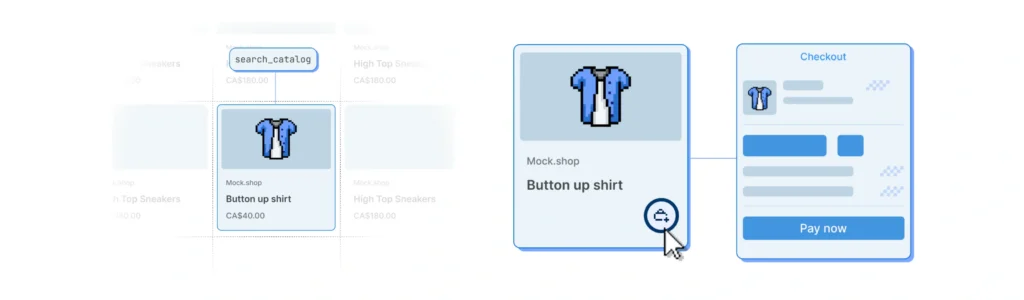
At a high level, agentic commerce refers to AI-driven buying experiences where an agent (not the shopper), handles discovery, selection, and checkout.
 
The hype isn’t coming out of nowhere.
 
BCG reports that traffic to U.S. retail sites from GenAI browsers and chat-based shopping tools increased 4,700% year-over-year, with those visitors spending more time on site and engaging more deeply than traditional traffic sources.
 
As for Shopify itself, their growing investment in AI agents and open standards like MCP opens up exciting possibilities for merchants looking to increase reach and reduce friction. We explored this in more depth in our earlier article: Shopify AI Agents & Open-Source MCP: What Merchants Need to Know.

The Promise of Agentic Commerce: Frictionless Buying at Scale

At a high level, the value proposition is compelling:
  • Customers don’t need to browse multiple sites
  • AI agents surface relevant products instantly
  • Checkout happens in seconds
  • Brands gain exposure beyond their owned channels
 
For simple, transactional purchases, this works well. If you sell a straightforward SKU with static pricing and unlimited inventory, agentic commerce can feel like a win.
 
But most growing Shopify B2B merchants, especially those integrated with NetSuite, don’t operate in that world.
 
Adoption is already well underway. A commercetools study found that 73% of consumers are using AI in some part of their shopping journey, and 70% say they’re at least somewhat comfortable with an AI agent making purchases on their behalf.
Agentic Storefronts - Shopify

Shopify B2B Merchants Don’t Just Sell Products, They Sell Rules

This is where the gap starts to show.
 
Most B2B and hybrid merchants rely on layers of logic that sit outside the product itself:
  • Customer-specific pricing and catalogs
  • Inventory rules tied to NetSuite as the source of truth
  • Minimum order quantities or volume discounts
  • Free shipping thresholds
  • Approval workflows
  • Special handling (gift notes, split shipping, custom invoicing)
 
These aren’t “nice to have” features. They’re core to how revenue is protected, margins are managed, and operations stay sane.

AI Agents Don’t See Your Edge Cases, They Just Skip Them

Today, agentic commerce engines typically focus on completing a purchase as fast as possible. That means:
  • They buy the SKU, not the full experience
  • They ignore conditional logic
  • They bypass custom checkout flows
  • They don’t validate ERP-driven rules in real time
 
If your store relies on those rules, and most NetSuite-connected merchants do, the AI isn’t simplifying your commerce stack, it’s stepping around it.

Inventory and Pricing Risks in Agentic Commerce

Losing control doesn’t always show up as a dramatic failure. More often, it’s subtle.
 
This risk is amplified when ERP integrations aren’t airtight. Studies cited by Ignitiv, referencing Panorama Consulting, show that nearly 50% of ERP integrations fail to meet expectations, often due to data mismatches and process misalignment.
 
For NetSuite-driven businesses, inventory accuracy is non-negotiable. If an AI agent surfaces a product that’s technically available on Shopify but already allocated or out of stock in NetSuite, you’ve got a problem.
 
Finance and operations trust NetSuite (not the storefront), as the system of record. When orders arrive that don’t respect inventory reality, manual intervention follows. You end up with orders that operations can’t confidently fulfill, and that’s when manual fixes start creeping in.
 
Manual work doesn’t scale.

When Pricing and Promotions Stop Behaving as Expected

Customer-specific pricing, negotiated contracts, or volume-based discounts are core to B2B commerce.
 
When an AI agent ignores:
  • Minimum quantities
  • Tiered pricing
  • Customer eligibility
 
If an AI agent bypasses those rules, merchants face margin leakage, customer disputes, or both. None of that shows up in the “one-click checkout” demo, but it shows up fast in real operations.

How Agentic Commerce Changes Brand Experience

This might be the most underestimated risk.
 
Your Shopify storefront isn’t just a transaction layer, but it’s where:
  • Trust is built
  • Differentiation happens
  • Complex purchases are guided
  • Customers learn how to buy from you
 
When the purchase happens entirely inside a chat interface, your brand becomes a line item or a card, a price and a product name, not an experience.
 
For B2B buyers, especially, that’s a step backward.

How to Think About AI Agents Without Losing Commerce Control

Here’s the important part: this isn’t an argument against agentic commerce.
AI has a real role to play in 2026 commerce:
  • Product discovery
  • Research and comparison
  • Customer FAQs
  • Reordering assistance
 
The problem starts when AI becomes the decision-maker without guardrails.

ERP-First Commerce Architecture Still Matters

For B2B merchants, especially those using NetSuite as their system of record, the future isn’t AI replacing your storefront.
 
The goal should be:
  • AI-assisted discovery
  • NetSuite governing pricing, inventory, and orders
  • Shopify owning experience
 
That requires intentional architecture, not shortcuts. It takes a dedicated team to understand how AI impacts your operations and act accordingly. That balance is what allows merchants to move faster without sacrificing control.

How Agentic Commerce Limits Merchandising and Upsell Opportunities

Upselling - eCommerce
Beyond brand and operational control, there’s another cost merchants often overlook: the ability to actively sell.
 
One of the quieter trade-offs of agentic commerce is what doesn’t happen during the purchase.
 
When customers buy through AI agents, they’re no longer navigating your storefront. That means they’re not exposed to the merchandising strategies that drive incremental revenue.
 
There are no:
  • Promotional banners highlighting limited-time offers
  • “New arrivals” or featured product sections
  • Cross-sell and upsell modules
  • Editorial content that educates and influences buying decisions
  • Email subscription prompts for product updates, restocks, or promotions
  • Educational lead magnets such as buying guides, spec sheets, or setup documentation
 
In an AI-driven flow, the purchase becomes purely transactional. The agent surfaces a product, confirms availability, and completes checkout. Everything else (the context, the storytelling, the nudges), disappears.

B2B Commerce Requires Structure, Not Just Speed

B2B buyers value:
  • Accuracy
  • Predictability
  • Familiar workflows
  • Confidence that the order will be fulfilled correctly
 
This aligns with broader B2B buyer expectations. Shopify Enterprise reports that 67% of B2B buyers now expect experiences similar to B2C, but with the added rigor of pricing accuracy, availability, and predictable fulfillment.
 
A beautifully designed self-service portal connected to NetSuite and well-designed storefronts still play a critical role in:
  • Account management
  • Reordering
  • Contract pricing
  • Support and documentation
 
AI can support that experience, but it can’t replace it.

What to Keep in Mind

  • Agentic commerce excels at convenience, not complexity.
  • If your business relies on pricing rules, inventory logic, or custom workflows, blind automation introduces risk.
  • Losing control doesn’t look dramatic, it looks operational.
  • Inventory mismatches, pricing errors, and support escalations add up quietly.
  • Brand experience still matters, especially in B2B.
  • AI can surface products, but it can’t replicate trust, guidance, or differentiation.
  • The future isn’t AI or control, it’s AI with guardrails.
  • The strongest commerce stacks treat NetSuite as the source of truth and AI as an assistant, not an override.

Control Is a Feature, Not a Limitation

Agentic commerce will absolutely shape the future of buying. But for mid-market Shopify merchants, especially those running on NetSuite, the real differentiator won’t be who automates fastest.
 
It will be who automates responsibly.
 
If you’re exploring how AI agents fit into your Shopify + NetSuite architecture (without sacrificing brand experience, pricing integrity, or operational trust), that’s a conversation worth having early.
 
Control isn’t the opposite of innovation. It’s what makes innovation sustainable.
Picture of Joaquin Varela

Joaquin Varela

CEO and Co-Founder of UnlockCommerce, with over a decade of experience in ecommerce and enterprise software. Former Senior Developer and Consultant at Oracle | NetSuite and Software Engineer at Amazon Europe.

Share this post

You may also like