
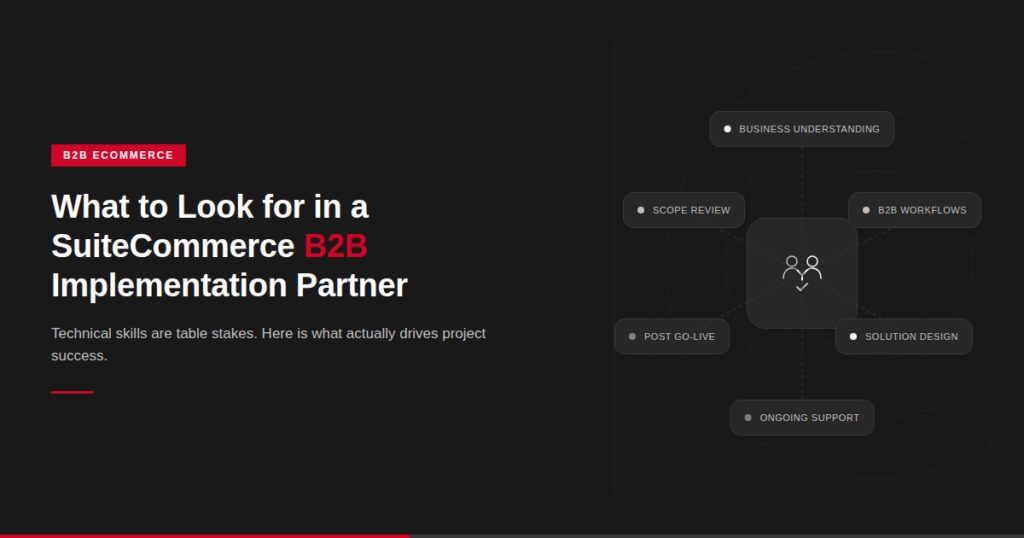
What to Look for in a SuiteCommerce B2B Implementation Partner (Beyond Technical Skills)

Your B2B buyers already know what they want to order. They know the SKUs, the quantities, and the delivery windows. What they don’t have patience for is a portal that slows them down, a search that doesn’t return the right results, or a checkout flow that forces them to pick up the phone anyway.

That’s the reality for most mid-market companies running SuiteCommerce Advanced (SCA), NetSuite’s native B2B eCommerce platform. The technology can support complex pricing, customer-specific catalogs, and self-service ordering.

But whether it actually does depends almost entirely on the SuiteCommerce B2B implementation partner you choose to build and maintain it.

And here’s the part most companies learn too late: technical skill is table stakes. What separates a partner that delivers results from one that just delivers code is how well they understand your business before they write a single line.

What to Look for in a SuiteCommerce B2B Implementation Partner (Beyond Technical Skills)

Table of Contents

The Real Differentiator Is Business Understanding, Not Just Code

Most SuiteCommerce agencies and NetSuite eCommerce partners can configure item lists, set up payment gateways, and deploy extensions. That’s the baseline. The problem is that B2B commerce isn’t generic. A distributor selling electrical components to retailers has completely different workflows than a bridal brand managing seasonal wholesale orders.

When a partner skips the work of understanding how your buyers actually interact with your catalog, how your warehouse processes orders, and where your sales reps spend their time fixing preventable issues, they end up building features that technically work but don’t solve anything.

A common example: a client needs a bulk order entry tool. A partner that only takes requirements at face value will build exactly what was described in the scope document. A partner that understands the business will ask, “How do your customers get the SKUs they need to place that order? Do they already have a feed? Do they download a catalog? Are they copying from a previous order?” Those questions change the solution entirely.

This is what the best SuiteCommerce customization experts do differently. They treat every feature as a business decision, not just a technical ticket.

What Goes Wrong When Your Partner Doesn't Know Your Business

The pattern is predictable. A B2B company selects a SuiteCommerce agency, signs a scope of work, and kicks off the project. Requirements are written in broad strokes. The partner builds what was described. Two months later, the client sees the result and says, “That’s not what I meant”. The B2B portal looks complete on paper but doesn’t match how their buyers actually place orders.

At that point, you’re paying twice: once for the original build and again for the rework. And the friction isn’t just financial. It damages trust between your internal team and the partner, slows your go-live timeline, and often leaves your B2B buyers dealing with a portal that feels like it was built for someone else’s business.

Here’s where it gets worse. In many implementations, the information collected during the sales process never fully reaches the technical team. The sales conversation captured context about your peak season, your top customer segments, and your biggest operational pain points. But if that knowledge stays in someone’s inbox instead of a shared document, the developers working on your project are building without the full picture.

This gap between what was sold and what gets built is one of the most common reasons B2B SuiteCommerce projects go sideways. It’s not a technology failure. It’s a process failure. And it happens at agencies of all sizes.

How to Evaluate a SuiteCommerce B2B Partner the Right Way

If you’re selecting a SuiteCommerce partner for a new implementation, a migration, or ongoing support services, here’s what to prioritize beyond the technical checklist.

They ask about your buyers before they ask about your requirements.

A good partner wants to know who’s using the site, what those users care about, and what “fast” means for them. For a B2B buyer, speed isn’t page load time. It’s fewer clicks to reorder, faster access to account-specific pricing, and less time spent searching for products they already know by name.
 
“This matters more than most companies realize. Industry research shows that 74% of B2B buyers would switch suppliers for a better digital buying experience, which means your portal’s usability directly affects customer retention”.

They challenge your scope, not just execute it.

If everything you ask for gets a “yes, we can do that”, be cautious. The best SuiteCommerce support services include a partner who says, “We can do that, but here’s why this other approach gets you a better outcome”. That pushback only comes from experience across similar B2B portal and storefront implementations.

They document solutions before building them.

A Solution Architecture Presentation or technical design document, shared with your team before development starts, dramatically reduces the “that’s not what I meant” problem. If your partner jumps straight to building without a written plan you can review, that’s a red flag.

They stay close after go-live.

The best SuiteCommerce agencies don’t disappear once the site launches. They monitor what’s working, flag issues they’ve seen in other accounts, and proactively suggest improvements. That kind of ongoing engagement is what turns a vendor relationship into a partnership.
Get these four things right and most of the common implementation problems disappear before they start.
At UnlockCommerce, this approach has been the foundation of 350+ NetSuite eCommerce projects, with a 95% customer satisfaction score. The pattern holds across industries: the deeper the partner understands the business, the fewer surprises show up in production.
 
Choosing a SuiteCommerce B2B implementation partner is a business decision as much as a technical one. If you’re evaluating partners or reconsidering your current setup, a 30-minute conversation with our team can help you identify where the gaps are and what closing them would look like.

FAQ

Timeline depends on complexity, but most mid-market B2B projects range from 8 to 16 weeks for an initial launch. Projects that include a proper discovery and solution design phase upfront tend to finish closer to the original estimate because there’s less rework during development.

A general NetSuite consultant focuses on ERP configuration, financials, and operations. A dedicated SuiteCommerce partner specializes in the commerce layer: storefront design, B2B self-service portals, extensions, checkout flows, and how all of that syncs back to NetSuite as the system of record. The distinction matters because SuiteCommerce has its own architecture, performance considerations, and UX patterns that ERP generalists rarely know well.

Yes. SuiteCommerce Advanced supports customer-specific pricing, tiered pricing, volume discounts, and restricted catalogs out of the box. The challenge is configuring those features so they perform well and actually match how your sales team and buyers operate, which is where partner expertise becomes critical.

Common signs include: slow response times, recurring issues that never get root-caused, features that technically work but your team doesn’t use, and a general feeling that you’re always explaining your business from scratch. If your partner can’t describe your top customer segments or your peak season without being reminded, that’s a gap worth addressing.

Implementation costs starts at $10k for SuiteCommerce, separate from NetSuite licensing fees. The biggest cost variable is usually how well requirements are defined upfront, not the technology itself.

Standard works well for B2B storefronts with core features like customer-specific pricing and quote management. Advanced is the right fit when you need custom checkout flows, proprietary extensions, or unique B2B portal experiences that go beyond configuration. A good partner will help you make this call before it becomes a mid-project scope change.

Yes. SuiteCommerce supports account management, invoice payments, order history, returns, and case management alongside product browsing and checkout. For many mid-market B2B companies, the self-service portal capabilities reduce more operational cost than the storefront generates in new revenue.

Share this post

You may also like