
- Industry: Personal Safety Supplies and Equipment
- Platform:

|
Let's Meet at SuiteWorld! → Oct 25-28 |
A SuiteCommerce to Shopify migration works for a NetSuite business when NetSuite stays the system of record. For Essco Indy, UnlockCommerce rebuilt the storefront on Shopify, moved collections and menus over in bulk, connected orders and inventory through the NetSuite Connector, and redirected every legacy URL.
Platform
SuiteCommerce to Shopify, built on UC Theme 1.0.0
Integration
NetSuite Connector for orders, fulfillments, inventory and product data
Catalog
Collections and the full menu hierarchy migrated from NetSuite with Matrixify
SEO
Legacy URLs mapped one by one to 301 redirects
Essco Indy is an Indianapolis supplier of personal protective equipment, containment supplies, chemicals and equipment for environmental remediation contractors. Their buyers work asbestos, lead, mold and water damage jobs. They usually know what they need. Respirators, poly sheeting, a HEPA vacuum by Friday.
That shapes how the store gets used. Contractors browse by category, drill into sub-categories and reorder. So the first rule of this project was simple: protect that browsing path, and keep NetSuite running inventory, orders and fulfillment behind it.
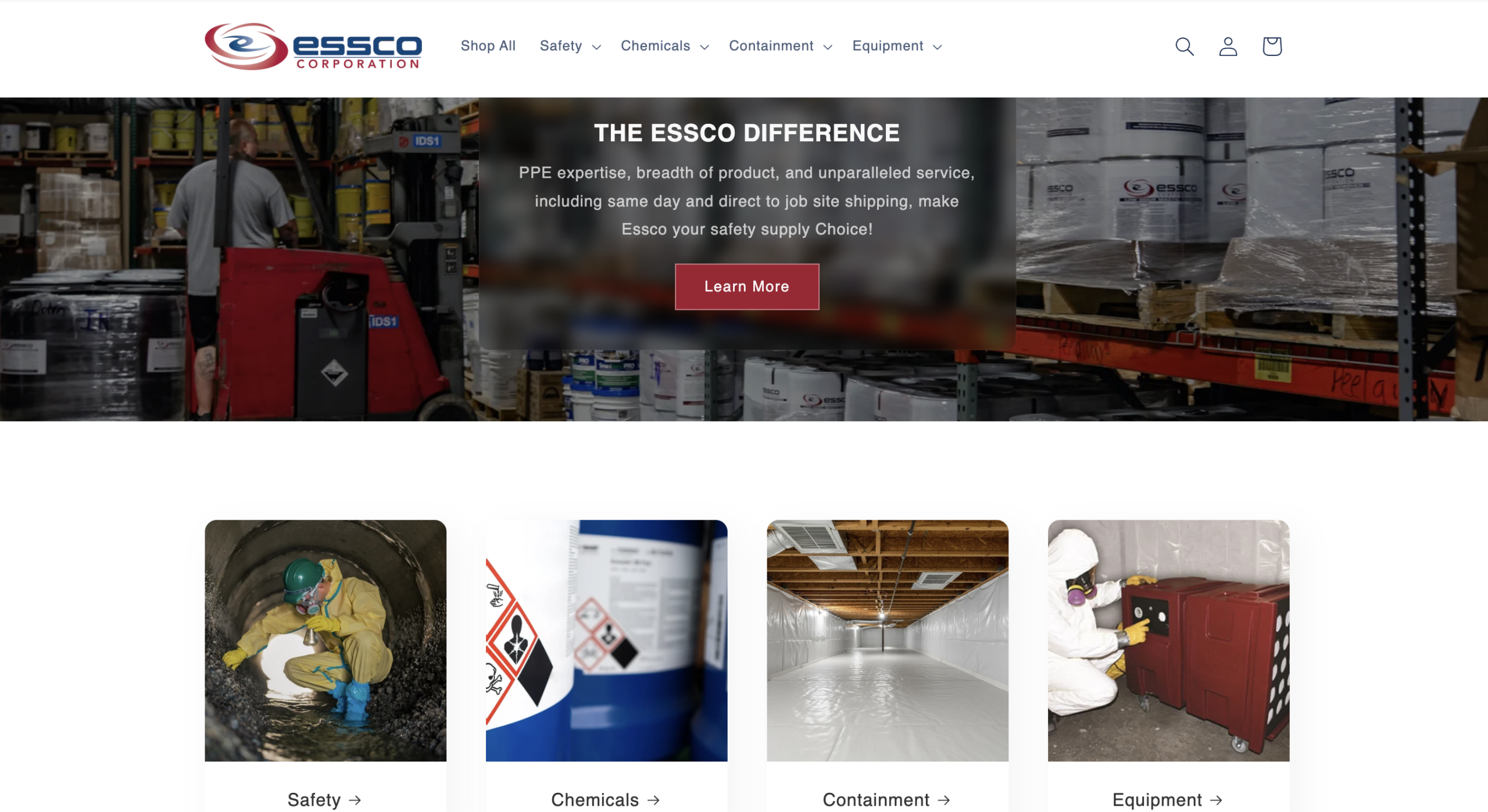
What we did: Recreated collection browsing, navigation and product pages on Shopify.
What it means for Essco: Returning customers find products where they expect them.
What we did: Built on UC Theme 1.0.0 and branded with Essco's logo, colors, typography, header and footer.
What it means for Essco: Their team edits content in Shopify's Theme Editor.
What we did: Rebuilt collections from NetSuite Commerce Categories, assigned products in bulk.
What it means for Essco: Same structure as before, no manual rebuild.
What we did: Imported the full SuiteCommerce menu hierarchy.
What it means for Essco: Every link and level carried over.
What we did: Recreated About Us, Terms and Conditions and Privacy Policy.
What it means for Essco: No gaps in site content at launch.
What we did: Native Shopify checkout with Shopify Payments and UPS carrier-calculated rates.
What it means for Essco: Shipping costs calculated automatically.
What we did: NetSuite Connector.
What it means for Essco: Orders, fulfillments, inventory and product data stay in sync.
What we did: Mapped old URLs to new ones with 301 redirects.
What it means for Essco: Rankings and bookmarks point to the right pages.
What we did: DNS cutover with Essco's IT provider, then post-launch support.
What it means for Essco: A coordinated go-live.
Essco’s catalog lives in NetSuite. The store follows it, not the other way around.
Shopify and NetSuite are connected through the NetSuite Connector. Web orders flow into NetSuite. Fulfillments sync back to Shopify, so customers see shipping updates. Product data and inventory come from NetSuite, which means the team updates an item once.
Images needed one more step. We wrote a custom NetSuite script that pulls each item’s images and maps them for the Connector. Up to three images per item now reach Shopify automatically. Nobody uploads them by hand anymore.
After 350+ eCommerce projects, this is the part we watch most closely. The storefront is what people see on launch day, but the ERP connection decides how the business runs the week after. It’s also why our NetSuite Connector services start with the data model, not the theme.
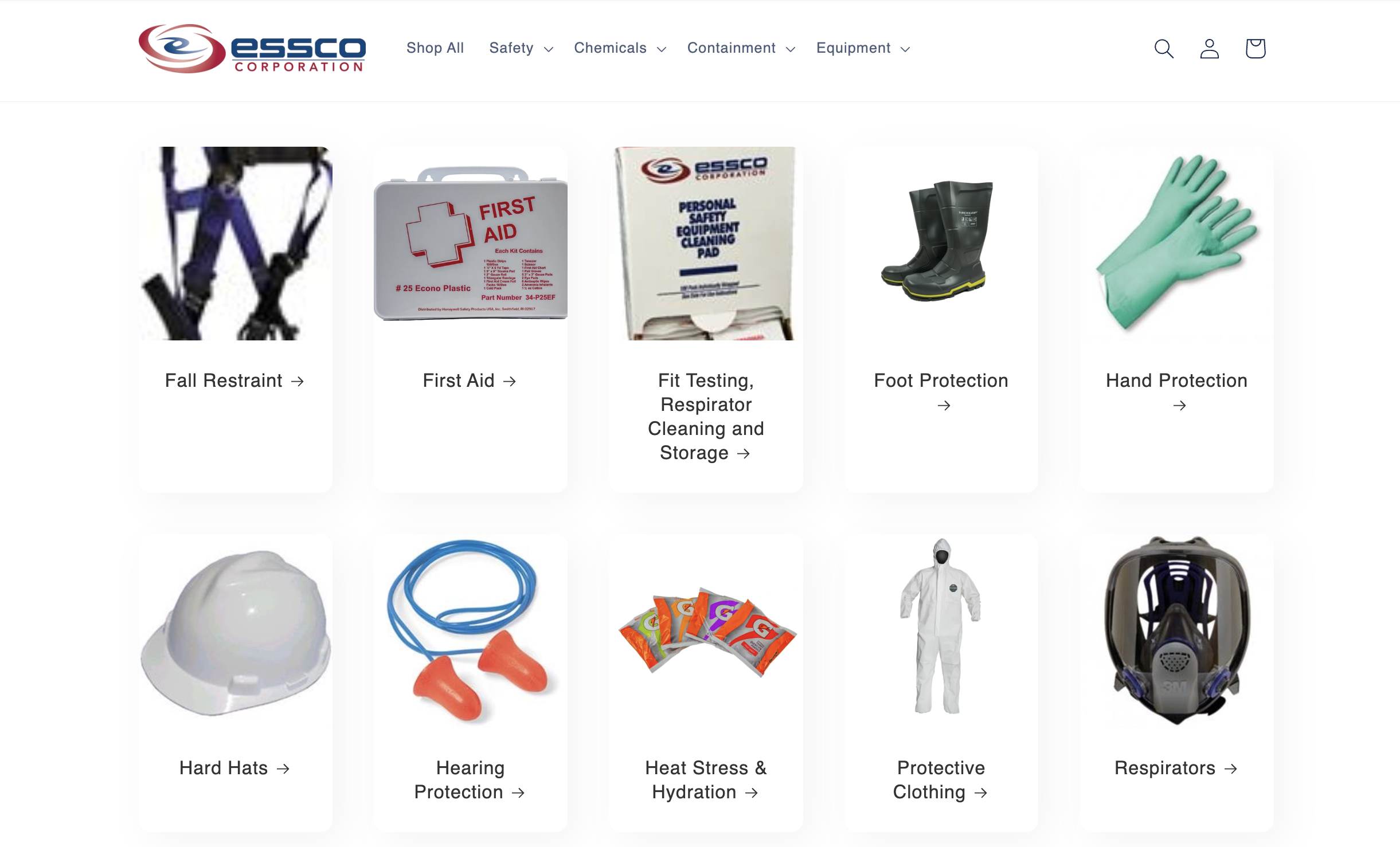
Shopify doesn’t support parent and child collections natively. For a catalog like Essco’s, that matters. “Fall Restraint” isn’t one list of products; it has its own categories inside it.
We rebuilt the hierarchy in the theme. Open the Fall Restraint collection and you’ll see image tiles linking to its sub-collections: Harnesses, Lanyards and Self-Retracting Lifelines. Contractors click through the same way they did on the old SuiteCommerce site. No new habits required.
Building a deep catalog by hand in Shopify is slow, and one wrong assignment puts a harness under chemicals. So we didn’t do it by hand.
With the Matrixify app, we:
The speed was nice. The bigger win is that the structure in Shopify mirrors the structure in NetSuite, which makes future changes much easier to trace.
Years of rankings can disappear over a weekend if old URLs break. We helped Essco identify their legacy SuiteCommerce URLs, mapped each one to its Shopify equivalent and set up 301 redirects. Search engines and customers with bookmarked product pages land where they should.
We kept custom work to the places that needed it: the sub-collection tiles and the image sync. Everything else runs on what Shopify already provides:
Fewer custom pieces means less to maintain. We also trained Essco’s team on Shopify Admin, so day-to-day store management stays in their hands.
After launch in October 2026, the Essco Indy homepage scored an A in GTmetrix, with 99% for Performance and 97% for Structure.
847 ms
Largest Contentful Paint (LCP)
When the main content is visible
35 ms
Total Blocking Time (TBT)
How long the page can’t respond to clicks or taps
0
Cumulative Layout Shift (CLS)
Whether the layout jumps while loading
542 ms
First Contentful Paint (FCP)
When the first content appears
194 ms
Time to First Byte (TTFB)
How quickly the server starts responding
1.0 s
Time to Interactive
When the page is ready to use
Google’s Core Web Vitals guidance treats an LCP under 2.5 seconds and a CLS under 0.1 as good. Essco’s homepage lands well inside both. Keeping the build Shopify-native, with custom code limited to two features, leaves less on the page to slow it down.
Before any theme work, answer these:
Yes. In Essco’s case, NetSuite stays the system of record. The NetSuite Connector sends web orders to NetSuite, syncs fulfillments back to Shopify and pulls product data and inventory from NetSuite.
Not natively. Shopify collections don’t have a built-in parent and child structure. The hierarchy can be recreated in the theme, as we did with Essco’s sub-collection tiles.
List every legacy URL, map each one to its new Shopify equivalent and set up 301 redirects before the DNS cutover.
For Essco, yes. A custom NetSuite script maps each item’s images for the NetSuite Connector, and up to three images per item sync to Shopify.
UnlockCommerce is a NetSuite Alliance Partner, SuiteCloud Developer Network member and Shopify Plus Partner. Our team is the original force behind SuiteCommerce, and we’ve delivered 350+ eCommerce projects for businesses running on NetSuite.
We know both sides of this move. See our Shopify development services or talk to our team about your project.
We are standing by ready to help. Just fill out this short form introducing yourself and someone from our team will follow up within one business day.