

SuiteCommerce vs SuiteCommerce Advanced: What B2B Distributors Should Ask When Pricing Lives Below the SKU

If price in your business depends on lot, origin or quality attributes rather than the part number, the SuiteCommerce vs SuiteCommerce Advanced decision is not about catalog size or storefront design. It’s about whether your NetSuite item data can be maintained once customers can see it. Start with the item record, then pick the edition.

Key takeaways

  • Pricing below the SKU is an ERP question first. SuiteCommerce runs on NetSuite, so what's on the item record is what the buyer sees.
  • Catalog size is rarely the problem. Data structure is.
  • Forcing matrix items onto an existing part numbering scheme can break purchasing, inventory and the references your customers already use.
  • SuiteCommerce Advanced is warranted by specific requirements (for example, a multi-subsidiary international setup, or a change that must touch core code), not by "just in case."
  • Do a technical discovery of the item and pricing model before anyone estimates.

A B2B parts distributor on NetSuite often asks the wrong question first: “Will the storefront look right?”. In a B2B setting, most buyers know the part they want. Look and feel have to be good enough. What decides the project is whether your team can keep pricing accurate once it’s exposed to hundreds or thousands of accounts. At UnlockCommerce, a NetSuite Alliance Partner with 350+ eCommerce projects delivered, that’s the conversation that settles most platform decisions.

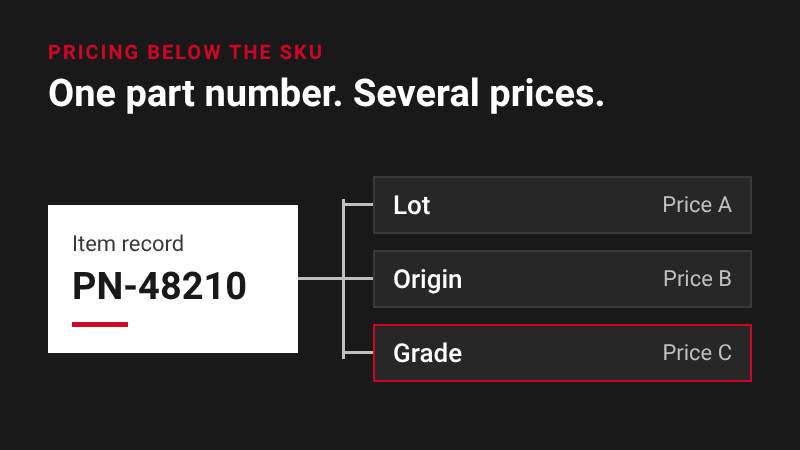
One NetSuite part number with several price structures by lot, origin and quality grade

Table of Contents

Can SuiteCommerce handle pricing that is not set at the SKU level?

SuiteCommerce runs directly on NetSuite, so it can only show what the item record and pricing setup hold. If origin-level price lives in custom fields, the storefront can expose it, but someone has to design how those fields map to what a buyer sees.

Some distributors carry the same functional part from different origins or lots. The SKU stays the same, but cost and price structure differ. NetSuite is the system of record for all of it, and in a typical SuiteCommerce setup there is no connector or middleware layer to reconcile. That’s a strength: one source of truth. It also means a messy item model is a messy storefront.

NetSuite item record feeds SuiteCommerce and the B2B buyer, with no middleware to reconcile

Out of the box, SuiteCommerce supports pricing levels and Personalized Catalog Views, with login required to see prices and buy if you want a public browse experience. Where your pricing logic goes beyond that, expect a custom extension and a scoped discovery. Our SuiteCommerce extensions cover pricing, inventory and B2B ordering needs like these.

Why is a large catalog not the real risk?

Hundreds of thousands of items can be exposed on SuiteCommerce, and we work with clients at that scale. The risk is not volume. It’s whether the data behind those items is clean, owned, and structured the way the storefront will read it.

Two practical points. First, the ERP catalog is not the web catalog. Sequence the decision: total items, how many are genuinely active, and how many should be published for sale online, with a named owner for each decision. Second, a clean-up before launch is cheaper than a clean-up after customers start seeing wrong prices. Scale calms down quickly once those three numbers are agreed. Structure is what keeps IT and finance up at night, and it is fixable.

The ERP catalog is not the web catalog: total, active and published items, each with an owner

Should you restructure part numbers or matrix items to fit a template?

Usually no. Matrix items generate a separate item per option, which changes the SKU a buyer orders since each option combination is a child item record with its own name/number. If your customers, purchasing team and inventory already rely on the existing part numbers, restructuring them to fit a template moves cost into every other department.

Restructuring into matrix items versus keeping the existing NetSuite part number

Matrix items are a legitimate NetSuite feature for variants like size and color. They are the wrong fix when the same part number must carry different price structures. The hidden cost is not the implementation. It’s the re-keying of purchasing, the inventory reconciliation, and the broken references on customer side. Our position at UnlockCommerce: shape the storefront around the data model the business already runs on, not the other way around.

Shape the storefront around the data model the business already runs on, not the other way around.

When do you actually need SuiteCommerce Advanced?

Choose SuiteCommerce Advanced when a requirement cannot be met through standard SuiteCommerce plus extensions, most commonly an international setup tying the site to different subsidiaries and tax IDs, or a change that has to alter core platform code. Catalog size alone is not a reason.

Decision path: SuiteCommerce plus extensions or SuiteCommerce Advanced

Oracle’s documentation states that both SuiteCommerce and SCA can be customized through extensions built on the Extensibility API, and that only SCA adds the option to extend source code when you need objects the API does not expose. It also advises against editing source directly and recommends the Extensibility API for maintainability (Oracle NetSuite Help: What Can I Customize?). That’s the practical test: if an extension can do it, you probably do not need SCA. Choosing SCA “just in case” tends to add budget and timeline you did not need. If you do have an existing SCA site, see our SuiteCommerce Advanced upgrade service.

What should you map in NetSuite before you scope the storefront?

Map where price, cost and availability actually live on the item record, which fields drive them, who maintains them, and which storefront selections must flow into the sales order. That discovery should precede any estimate.

The questions to ask first

1Where does price live: item, price level, custom field, or lot?
2Which attributes (origin, quality grade, lot) change price or restrict fulfillment?
3Must a buyer's selection carry into the sales order and limit which lots can fulfill it?
4Who owns maintenance of each field today, and does that change when customers see it?
5How many of your items are active, and which should be published?
6Do you operate across subsidiaries or tax IDs, or touch core platform behavior?

A good partner will ask these before quoting. If you are comparing partners, our guide on how to choose a SuiteCommerce B2B implementation partner covers what to expect.

How does the UnlockCommerce approach compare to the typical one?

Typical approachUnlockCommerce approach
First stepPick a template and estimate from featuresTechnical discovery of item record and pricing model
Part numberingAdapt data to the storefront (for example, matrix items)Adapt the storefront to the data model in NetSuite
Edition choiceSCA "to be safe"SC plus extensions unless a specific requirement forces SCA
Pricing logicWorkarounds outside NetSuiteExtensions reading NetSuite data, one source of truth
Risk surfacedAfter buildBefore estimate
Trade-offFaster quoteSlower first week, fewer surprises later

The trade-off is honest: a discovery step delays the quote. It also prevents the two-data-model problem, where a team maintains pricing in NetSuite and again for the web.

SuiteCommerce vs SuiteCommerce Advanced FAQs

No. Catalog size is not the deciding factor. Specific requirements are, such as multi-subsidiary international operation or changes that need core code access. Verify against current NetSuite documentation for your account.

It is a legitimate requirement and usually calls for a custom extension plus NetSuite configuration. Scope it during discovery, because it touches both the storefront and the sales order.

Generally no. SuiteCommerce runs on NetSuite, so what’s configured on the item record is what appears on the storefront. That is why the data model matters so much.

Fewer than your ERP holds, in most cases. Decide total, active, and publishable counts separately, and assign an owner to each decision.

Next step

Book a short audit of your NetSuite item and pricing model. You get a report on what native SuiteCommerce exposes, what needs an extension, and whether SCA is really necessary.

Picture of Marcos Mansilla

Marcos Mansilla

Marcos Mansilla is Engineering Manager at UnlockCommerce, with a robust background in software development and team leadership. Marcos specializes in guiding engineering teams to deliver high-quality, scalable, and efficient solutions tailored to meet client needs. His expertise in SuiteCommerce and Shopify and deep understanding of NetSuite and eCommerce systems ensure seamless execution and innovative results for our clients. Marcos is dedicated to fostering collaboration and driving excellence across all technical initiatives.

Share this post

You may also like